
Words + photos by Steph Sheldon

I meet Hasan at Café de la Poste on a soft, golden morning during Ramadan. He’s already been up for hours — had his tea long before my alarm ever went off — and is halfway through a conversation with the waiter when I arrive, still jet-lagged and fumbling for dirhams I haven’t yet exchanged.
He pays for my espresso without hesitation, like this has all happened before. He’s sharply dressed in a way that feels lived-in and effortless. Buttoned shirt, crisp jacket, confident smile. And before I can finish my first sip, he’s off — and I’m swept up in what becomes one of the most unexpectedly inspiring days I’ve had in Morocco.

Stop One: A Gallery, a Curator, a Conversation in Three Languages
Our first stop is a small but striking modern art gallery in Gueliz. White walls, high ceilings, soft light. Hasan is instantly at home here. He greets the 30-something curator like an old friend — their conversation flowing easily in French, dipping into English, laughter layered on top like punctuation.
This is who Hasan is: at ease in any space, genuinely interested in everyone he meets, and somehow connected to everyone. He introduces me as a photographer, tells a quick story that makes me blush, and is out the door again before I can take his portrait.

The Blur Between Stops
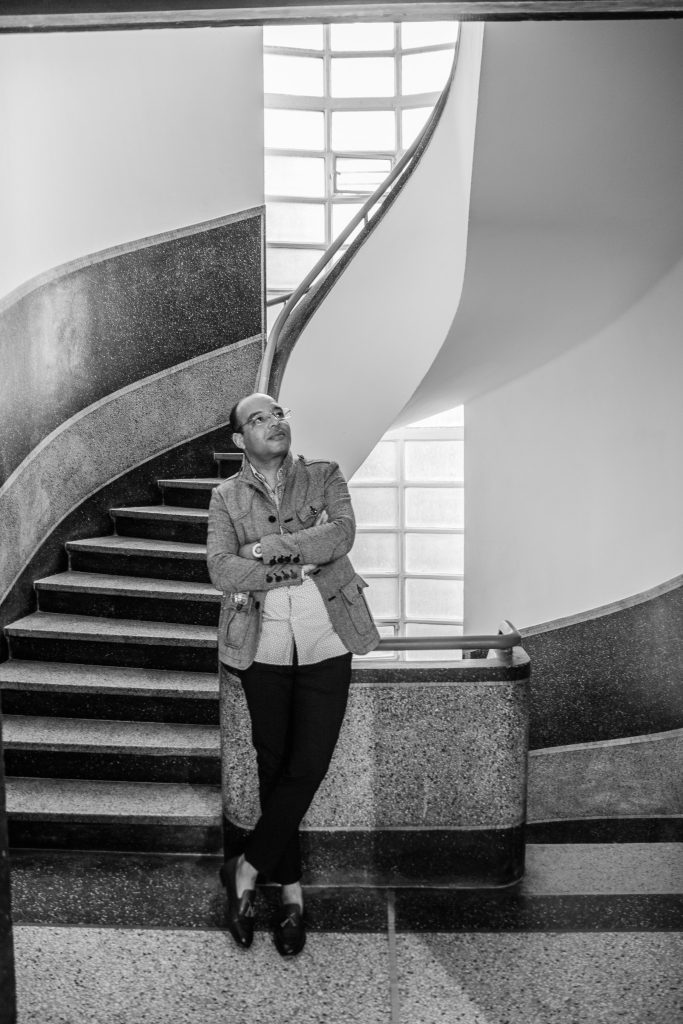
Trying to photograph Hasan is like trying to hold water in your hands. By the time I lift my camera, he’s already crossed the street, ducked into a bookstore, or turned his attention to the next piece of art. He moves fast — not out of impatience, but purpose. There is always somewhere worth being.
We visit a contemporary gallery packed with surprises: massive canvases, ornate ceramics, and the newest piece of the owner’s vision — a studio space for emerging African artists, fully equipped and ready for creation the moment they arrive in Marrakech. No agenda. No press release. Just art for the sake of making.

Gueliz, Through Hasan’s Eyes
As we walk, the city unfolds differently through Hasan’s commentary. He tells me about the balconies that once marked Jewish homes. The layered facades of French colonial design. The antique shops filled with treasures but off-limits to cameras — “you have to feel these places,” he says. And I do.
There’s a reverence in how he talks about Marrakech. A seriousness that doesn’t push you away — it pulls you in.

Finally Still
At our third gallery, something rare happens: Hasan stops moving. He settles onto a bamboo chair, picks up an art book, and flips to a familiar page and has a surprised smile on his face. It’s a feature on a gallery he helped run in Tangier — a space that, for a time, became a magnet for artists from around the world. “Those were wild years,” he says, grinning. “We lived differently back then.” Now, he lives quietly in Marrakech with his wife. Their home, he tells me, is filled with art. Friends’ work. Pieces collected over decades. So many, in fact, that “my wife is a saint for letting it take over the house.”
I believe him.


The Last Word
We end the day at the Museum of Moroccan Elegance — a name that feels both accurate and understated. It’s quiet. Curated. Thoughtful. Hasan disappears into a conversation with a staff member by the entrance. I head to the rooftop restaurant, order a cold mocktail, and exhale into the golden light. One day with Hasan and I see Marrakech differently. Not louder or brighter — just deeper. The layers don’t flatten out. They multiply. And I can’t wait to return to them.
Want to experience Marrakech through Hasan’s eyes?